

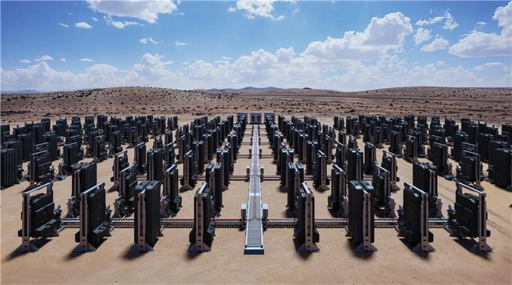
…Redwood believes that by 2030, end-of-life batteries could supply more than 50 percent of the entire energy storage market. Instead of grinding up used batteries to reclaim the critical materials inside, put them to work storing electricity. There have been many experiments done that re-purpose used EV batteries which no longer can supply enough power to meet the need for rapid acceleration in an EV but still have up to 80 percent of their original energy storage capacity available…
…Traditional energy storage systems are high density and require heavy-duty cooling. To avoid this, Redwood’s team opted for an open-air, low-density system mounted on above-ground cable trays.
Spreading packs out in the open air helps avoid the need for active refrigeration, and stripping away moving parts like fans and filters minimizes potential reliability failures. Keeping the wiring above ground and limiting the size of each modular component minimizes the need for large equipment. As Sun explained, the result is a storage system that is faster to build, easier to inspect after storms, and cheaper to keep running over time…
That’s an illogical and likely outdated perspective on battery capacity. I voluntarily charge my battery to 80%, both to prolong its life and because 80% is more than enough to meet my driving needs with only one charge per week. I also get a faster charge due to the taper of the power curve.
80% for me is 400 km / 248 miles of range, or 57 km / 35 miles per day. My commute to work is twelve miles each way.
If my battery drops to 80% capacity over a decade, it won’t affect me. I’d still have plenty of overhead with 400 km / 248 miles between charges.
What car is that?