

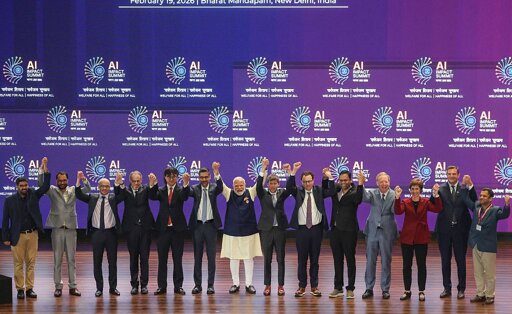
The world’s largest-ever AI summit took place in India this week, with hundreds of thousands of people, including world leaders and CEOs of AI companies, descending upon New Delhi for six days.
It was the fourth in a series of summits that were initially designed as a place for governments to coordinate global action in the face of threats from advanced AI.
India’s technology minister Ashwini Vaishnaw said at least 70 signatories were expected to commit to what has been dubbed the “Delhi Declaration” on AI at the summit. Few details were available about that declaration, except that it pledged that “AI’s promise is best realised only when its benefits are shared by humanity,” according to a European Union press release. Vaishnaw said the final draft would be released on Saturday, along with a full list of signatories.
China, the world’s second largest AI power and India’s strategic adversary, was all but absent from the summit, which fell on the same week as Chinese New Year.
And the White House made it clear in Delhi that the U.S. would reject any attempt to regulate AI at the global level. “We totally reject global governance of AI,” White House official Michael Kratsios said on Friday.
Official “frontier AI commitments” released during the summit made no overt mention of previous summits’ attempts to coordinate government action on addressing AI risks. Instead, a set of voluntary commitments announced by the Indian government emphasized the importance of sharing data on real-world AI usage and building mechanisms to improve AI in under-represented languages.
“Full global consensus on how to govern AI is a far cry from reality,” says Isabella Wilkinson, a research fellow at the British foreign affairs think-tank Chatham House. “The core issue is how to incentivize countries and companies to get around the same table … despite fragmented geopolitics, intense competition, and the drive for ever-more powerful and -profitable AI. None of this is particularly conducive to global cooperation.”
Why do I feel the declaration will be garbage and just allow tech bros to continue their bullshit.
Because the tech bros building it are guiding the conversion. Based on promises that we have no reason to assume they can deliver.
And the same tech bros threatening clueless politicians with even more outlandish lies:
The article is pretty good at underscoring some of the other BS outside of the technical side of things